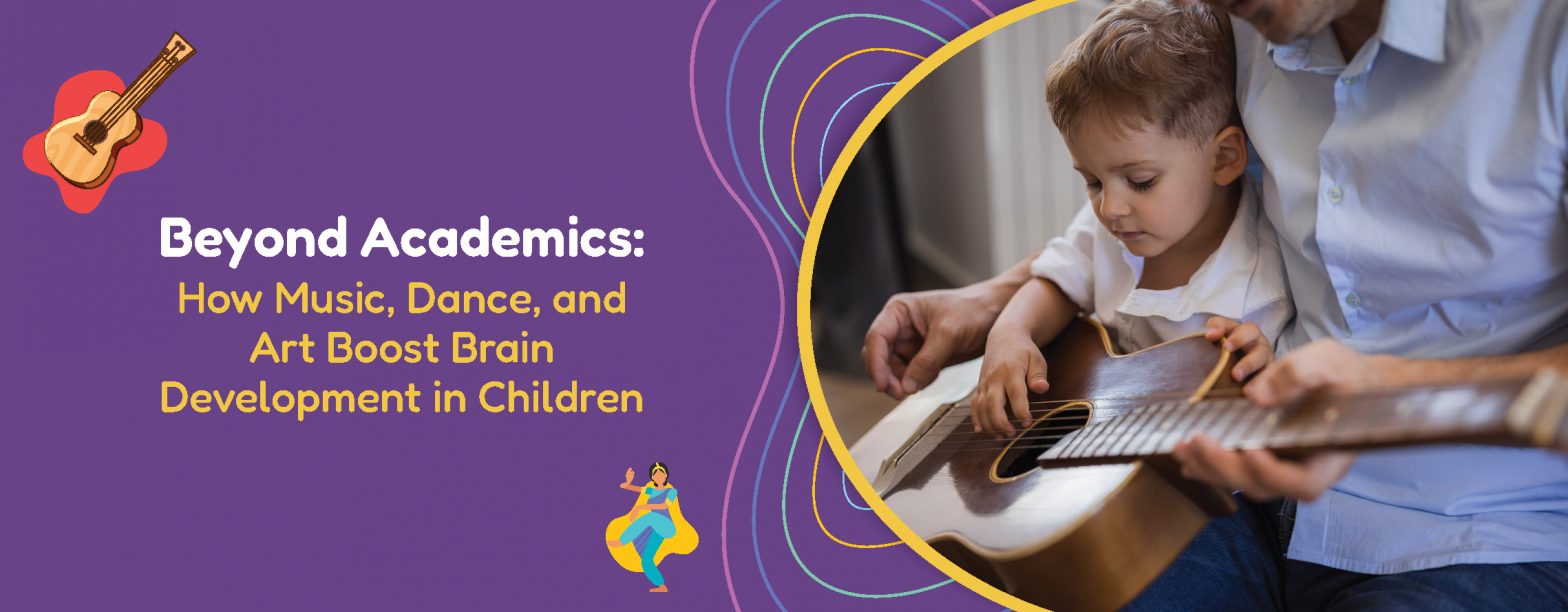
How Music, Dance & Art Improve Child Brain Development
Picture a kid’s school day. Math, science, reading, – those tend to dominate the list of our imagination. But learning doesn’t happen only through textbooks. Music hums its way into memory. Movement builds thinking in ways sitting still never could. Paint on paper shapes more than pictures – it moulds young minds quietly.
Childhood is a phase when the brain develops millions of neural pathways. What happens to children early shapes how they understand things, pick up knowledge, even share feelings down the road. Making art, playing music, drawing, all of these can do more than just entertain; creative tasks activate various brain regions simultaneously, which lead children to develop enhanced cognitive, emotional, and social skills.
That’s why currently a lot of teachers promote the importance of arts in the growth of children. Music, dance, and visual art that are merely considered as a source of amusement do help children to think better, gain more confidence, and learn more effectively.
The Science Behind Arts and Brain Development
Arts are a great way to activate our brain with new and exciting experiences. A child, for instance, learns by singing a song, painting a picture, or dancing to a choreography. All while simultaneously processing sound movement, colours, feelings, and patterns in their mind.
This kind of multi-sensory exposure not only creates and consolidates neural pathways but also fosters brain flexibility.
Studies by notable bodies such as the National Endowment for the Arts indicate that children who spend time in arts education regularly tend to demonstrate enhanced problem solving skills, better social abilities, and increased academic persistence.
Creative arts can be instrumental in brain development as they can help:
- Strengthen connections between different brain regions
- Improve attention and memory
- Develop imagination and creative thinking
- Express emotions and ideas more confidently
This is actually one of the reasons that a number of schools nowadays are opting for STEAM education (Science Technology Engineering, Arts, and Mathematics) instead of focusing solely on STEM. The inclusion of arts gives kids the freedom to blend creativity with reasoning.
How Music Improves Memory and Learning
Music has a huge impact on the formation of our brains. Kids who learn music not only listen to melodies but also get better at distinguishing various patterns, memorizing beats, and coordinating their body movements with musical sounds.
Research from the Brain and Creativity Institute at the University of Southern California suggests that engaging in musical training can promote development of the brain regions involved in language and reading.
How music benefits children
- Improves memory and concentration
- Supports language and listening skills
- Helps children recognise patterns linked to mathematical thinking
- Builds patience and discipline through practice
While practicing music makes kids more disciplined and patient, children involved in the school choir or an instrumental music class also build their self esteem and team working skills. Besides, performing in front of an audience teaches them how to express their thoughts and feelings and conquer their fear of getting up on stage.
How Dance Builds Focus and Coordination
Dance also keeps children physically active, which is a great way to accomplish the ultimate goal of every cognitive enhancement program for children: improved brain function. Actually, a large number of teachers are of the opinion that engaging in physical activities with movements used as a medium for learning makes it easier for students to pay attention and to keep their interest in studies over longer periods of time.
Dance is far more than just an act of physical movement, it is also a form of thinking, timing and expression. While children are learning dance routines, their brains are engaged in most of the activities such as memorizing sequences, coordinating body parts, and staying in tune with the music. This entire process helps in building brain connections around attention and physical skills.
Besides, dance is an excellent medium for children to get exercise, being physically fit has a significant relationship with superior brain functioning.
Benefits of dance for child development
- Improves coordination and balance
- Strengthens focus and concentration
- Enhances memory through learning choreography
- Encourages emotional expression and confidence
A lot of teachers are convinced that movement-related learning is a practical tool to keep children more interested in attending lessons.
How Art Encourages Creativity and Fine Motor Skills
Art is a great way for kids to release their natural creativity and imagination. It allows them to explore their thoughts and feelings in an effective and tangible way. Through painting, drawing, or crafting, children are able to bring out their ideas visually and, at the same time, be engaged in learning the qualities of patience and focus that are essential to a successful life. Besides emotional and intellectual development, the arts aid in the improvement of fine motor skills as children use their hands to handle tools like brushes, crayons, or scissors.
Benefits of art activities
- Enhances hand, eye coordination and fine motor skills
- Fosters creativity and original thinking
- Supports children in expressing their emotions and ideas
- Strengthens self esteem through creative exploration
Relaxation and unwinding through creative expression of feelings that have not yet been verbalized are some of the reasons children turn to art.
Why Creative Arts Matter in Schools
Alongside academic teaching, a really comprehensive education should also include creative experimentation. Offering music, dance, and art as part of the curriculum gives children a chance to unearth their talents that they might not have the opportunity to explore through other means. Moreover, these experiences also contribute to the development of children’s skills such as cooperation, self-discipline, and the ability to express oneself.
| Creative Arts Activity | Brain Development Benefit |
| Music training | Improves memory and language processing |
| Dance and movement | Enhances coordination and focus |
| Visual arts | Strengthens creativity and fine motor skills |
| Performing arts | Builds confidence and communication |
For parents considering school admissions in Pune, choosing a school that values arts education can make a significant difference in a child’s overall development.
Conclusion
Curiosity often sparks where paint meets math. A classroom might hum not with answers but questions when crayons join calculators. Confidence slips in quietly during moments of making something new. Learning sticks better if it arrives with rhythm.
At WWS, we think that if children are guided in exploring creative arts along with studies, they become inquisitive and fearless learners. By nurturing creativity early, schools and parents can help children build the skills they need to thrive both in school and beyond.
Occasionally, our learners carry more than books home. Their minds remain active as they transform their silent thoughts into words. This is the method through which we nurture tomorrow’s capable and self, assured young learners.
FAQs
How does music improve brain development in children?
Music activates brain areas responsible for memory, language, and recognizing patterns, and this leads to the strengthening of children’s cognitive abilities.
Can dance improve a child’s attention span?
Definitely. Apart from that, the mental effort required to learn dance sequences translates in the improvement of areas such as coordination, focus and memory. This in turn sets the stage for better academic learning.
What role does art play in a child’s life?
Art is a form of self-expression and an effective educational tool. Besides enabling youngsters to develop physical dexterity, it also arouses their imagination and emotional maturity. Consequently, art prompts the brain to develop in a well, rounded and wholesome manner.
Should schools still include arts in their curriculum?
Absolutely, they should. Apart from education, artistic creativity provides children with the means to come up with solutions, deliberate critically, and converse effectively.
Sources & Further Reading
- University of Southern California – Brain and Creativity Institute
Research about brain development in children and how it’s affected by music training.
https://dornsife.usc.edu/bci/brain-and-music-program/ - USC News – Music Training and Brain Development in Children
Article explaining how music education supports cognitive and language development.
https://today.usc.edu/music-training-can-change-childrens-brain-structure-and-boost-decision-making-network/ - National Endowment for the Arts – Arts and Early Childhood Development
Research revealing that arts participation can play an important role in supporting children’s social, emotional, and cognitive development.
https://www.arts.gov/impact/research/publications/arts-early-childhood-social-and-emotional-benefits-arts-participation - National Endowment for the Arts – Why Childhood Arts Experiences Matter
Insights into how arts education contributes to learning and development.
https://www.arts.gov/stories/blog/2025/educating-ourselves-about-childhood-arts-experiences-and-why-they-matter - PubMed – Music Training and Child Development Research Review
Scientific research examining how music training affects brain structure and behaviour.
https://pubmed.ncbi.nlm.nih.gov/29508399/