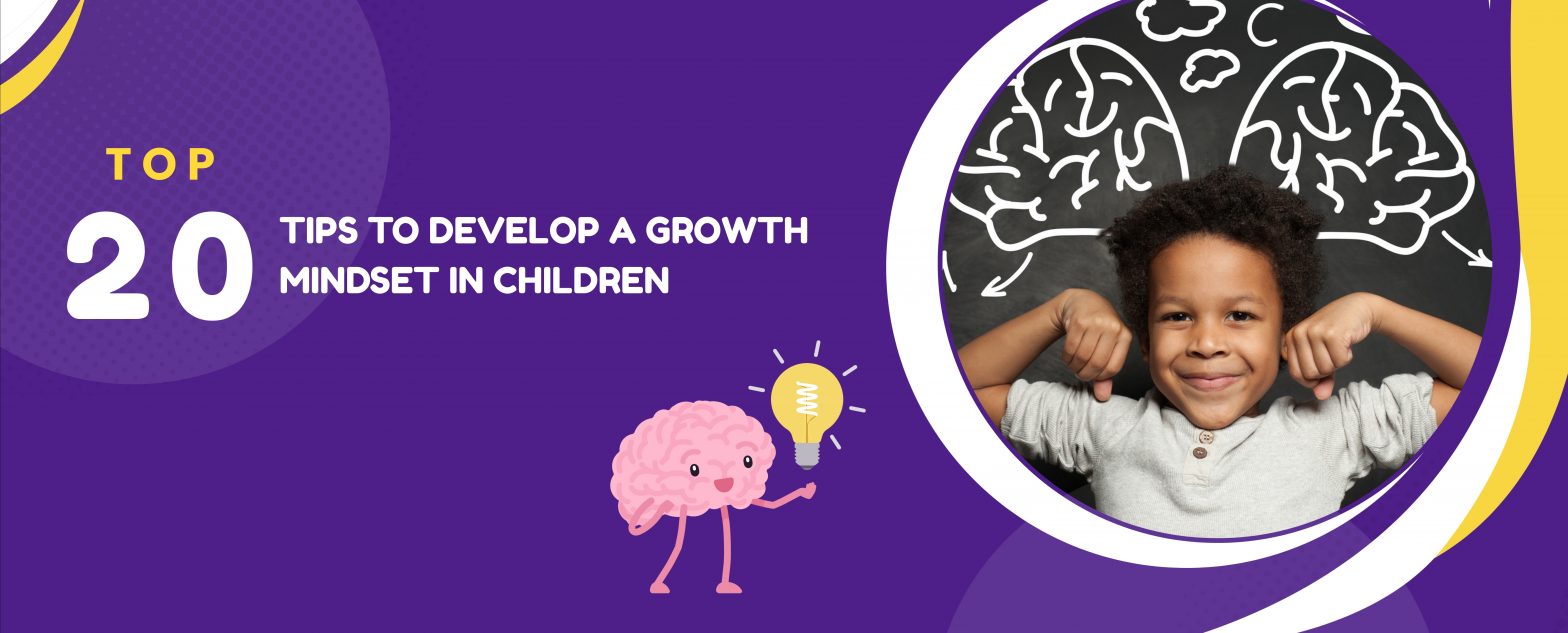
Top 20 Tips to Develop a Growth Mindset in Children
Helping children develop a growth mindset is one of the most powerful gifts parents and educators can give to them. A growth mindset teaches kids that abilities can improve with effort, challenges are opportunities to learn, and mistakes are stepping stones-not setbacks.
In this blog, you’ll learn:
✔ What growth mindset is in children
✔ Step-by-step approach on how to teach a growth mindset
✔ Top 20 recommended growth mindset tips for kids
✔ Growth mindset activities for kids
✔How parents and teachers influence the mindset of a child:
✔ Benefits of growth mindset in children
What Is Growth Mindset in Children?

Growth mindset is the belief that skills, intelligence, and abilities improve through practice, effort, and learning. This is in contrast with the fixed mindset, in which children believe an ability cannot be changed.
Signs of growth mindset in kids include:
- Being open to new experiences
- Accepting that mistakes are part of learning
- Seeking to ask questions, seeking assistance
- Practicing positive self-talk
Recognizing such signs helps parents assess the child’s learning attitude and redirect them along the proper path.
Why Is Growth Mindset Important for Children?
Research in child psychology points out that children who view skills are flexible are more likely to:
- Perform better academically.
- Build confidence and emotional intelligence.
- Show stronger resilience
- Stay motivated even after failure
- Develop lifelong learning habits
These benefits make the building of a mindset in kids quite foundational in modern parenting and education.
Fact check: Research indicates that growth mindset training can improve academic performance by 12-15%.
Did you know? A study of 1,260 children found that those with a high growth mindset had higher psychological well-being and school engagement owing to better resilience.
These benefits make growth mindset building significant in modern parenting and education.
How to Develop a Growth Mindset in Your Child: Expert Tips
Below are the top 20 growth mindset tips for kids, grounded in child development research and practical parenting strategies.
1. Teach Kids That the Brain Grows With Practice
Explain that the brain is a muscle and the more they use it, the stronger it gets.
This simple analogy helps children to fathom the basic difference between fixed and growth mindset.
2. Model a Growth Mindset Yourself
Children imitate whatever they observe.
Use phrases like:
- ‘I am still learning this.’
- ‘Mistakes help me grow.’
3. Praise Effort, Not Just Results
It is from the way we praise children that they come to develop a mindset about learning. When praise is focused only on results, then children can feel that they must always succeed. Praising effort, strategies, and persistence helps children understand that learning involves trying, improving, and not giving up.
Avoid general praise (‘Great job!’) and instead use more specific, effort-based feedback:
- ‘You really did a great job working on this!’
- ‘I loved the strategy that was used.’
- ‘You didn’t give up, even when it was tricky.’
Praise like this builds confidence and encourages a healthy, positive mindset.
| Instead of saying | Try saying |
| You’re so smart. | You put a lot of effort into this. |
| You got full marks! | I can see how much you practiced. |
| That was easy for you. | You kept trying until you figured it out. |
| You’re the best at this. | Your strategy really worked well. |
By shifting praise from who the child is to what the child does, parents help children stay motivated, confident, and willing to take on new challenges.
4. Encourage Kids to Embrace Challenges

When children are presented with a difficulty, their immediate response is to avoid it. Parents can support children by encouraging not to view difficulties as something to fear, but rather as opportunities to grow.
Explain to your child that when they struggle with a task, it means their brain is learning something new. Let your child understand that it is not necessary for them to do everything right in the first attempt. But what is important is practicing it again and working out different ways to resolve the problem.
When your child feels stuck, rather than guiding right away, you can ask your child these questions:
‘What can you try next?’
‘Is there another way to do this?’
‘What worked before that might help now?’
Such questions promote thinking and exploration in children and can help them believe in their capacity to arrive at solutions. Gradually, children will become less intimidated by failure and be very confident in dealing with situations by themselves.
Through constant encouragement of effort and problem-solving, parents can make children realize that obstacles in learning are stepping stones and not roadblocks.
5. Teach Kids to Reframe Mistakes
When your child makes a mistake in something or fails, try to help him or her gently shift the focus from what went wrong to what they can do differently next time. Instead of feeling discouraged, help your child view mistakes as useful learning moments rather than failures.
Encourage your child to replace negative thoughts like ‘I failed’ with more helpful questions such as:
‘What did I learn from this?’ or ‘What can I try differently next time?’ Learning to reflect this way plays an important role in keeping children motivated. When children know that mistakes will make them grow, then they will have no problems giving it a second try, staying engaged, and building confidence in their abilities.
6. Set Achievable Mini-Goals
Mini-goals are minor, achievable steps that lead toward a bigger goal. Unlike long-term goals-which sometimes feel overwhelming or too far away in the future, mini-goals give kids little accomplishments along the way. For instance, instead of saying something like, ‘I will read a whole chapter’, a mini-goal could be to say, ‘I can read five pages today’.
In fact, it is as important to celebrate small wins on the way towards achieving a big goal. By praising effort and progress, such as ‘You finished five pages—that’s amazing!’, this reinforces the idea that consistent effort leads to improvement. Mini-goals build confidence, keep children motivated to try and ultimately make bigger challenges more achievable over time.
7. Use ‘Yet’ Statements
The addition of the word ‘yet’ transforms fixed mindset statements into growth mindset ones in a very simple yet powerful way. This helps kids understand that abilities aren’t fixed; they can improve with practice.
For example:
Instead of saying, ‘I can’t do this,’ encourage them to say, ‘I can’t do this yet.’
This small change reminds children that learning is a process. It encourages patience, persistence, and the belief that with effort, they will improve. Using ‘yet’ over time helps kids develop resilience and a more positive approach toward challenges.
8. Read Books on Growth Mindset
Stories are fun and a powerful way to help children understand growth mindset ideas. Reading together allows kids to see examples of persistence, creativity, and learning from mistakes in relatable situations. Some excellent books that illustrate growth mindset concepts include:
- The Most Magnificent Thing
- The Girl Who Never Made Mistakes
- Your Fantastic Elastic Brain
These stories teach children, through simple narratives, that challenges and mistakes are part of learning-and that growth comes from effort and creativity.
9. Practice Daily Affirmations
Daily affirmations help children build a strong, resilient mindset by reminding them of their capability to learn and grow. You can introduce affirmations by explaining: These are positive statements we say to ourselves to stay confident and motivated, especially when something is hard.
Examples include:
- I can learn anything.
- Well, mistakes help me grow.
- I can keep trying and get better.
By practicing affirmations daily, children learn to concentrate on effort, learning, and belief in oneself, which permits them to build confidence and a growth-oriented mindset day in and day out.
10. Teach Kids to Set Learning Goals
Rather than emphasizing outcomes such as getting good grades or winning, it is important to help children set learning goals. Learning goals allow children to see their progress because they are based on efforts rather than outcomes.
For instance:
Rather than saying, ‘I want an A in math,’ teach them to want, ‘I want to improve my problem-solving skills in math.’
‘I want to win a swimming competition,’ can be rephrased as, ‘I want to improve my swimming technique and endurance.’
An approach like this focuses on growth, effort, and skill, making challenges more manageable and a motivation function more feasible.
11. Introduce Growth Mindset Activities for Kids
Research indicates that curiosity-driven activities, like puzzles, hands-on experiments, and STEM challenges, have the potential to enhance resilience and strengthen engagement in learning activities.
Some of these fun and practical activities include:
- Brain teasers and logic puzzles will enhance problem-solving and persistence.
- Lego problem-solving encourages creativity and planning.
- Growth mindset journaling: The kids reflect on challenges, mistakes, and progress.
- STEM experiments: These will help nurture curiosity and hands-on exploration.
These activities teach children that it is great fun to explore, experiment, and learn from mistakes, helping them develop a much stronger growth mindset.
12. Encourage Curiosity and Asking Questions
Curiosity is an important element of a growth mindset. When children ask a question, react with curiosity and excitement. For instance:
‘That’s a fantastic question—let’s examine it together!’ Such an approach conveys to children that inquiring is important and acquisitions are a continuous process. Therefore, it inculcates in children the habit of thinking critically and learning with curiosity rather than trembling with fear.
13. Share Real-Life Stories of Famous Failures
Children might view success as happening right away, but sharing how well-known individuals experienced repeated failures helps children understand that this isn’t usually true. For instance:
Walt Disney was fired from a newspaper for ‘lacking creativity.’
Thomas Edison failed to develop the light bulb in thousands of attempts; therefore, he invented the light bulb.
J.K. Rowling faced a lot of rejections before Harry Potter was published.
These samples teach children that behind every successful story, there are a lot of challenges, mistakes, and setbacks. By seeing how effort and perseverance pay off, children learn the importance of persistence in reaching their own goals.
14. Avoid Labels Like ‘Smart’ or ‘Gifted’
Instead of saying things like, ‘You’re so smart,’ or ‘You’re gifted,’ which sounds like praise but can reinforce a fixed mindset. Parents can say:
- ‘You worked really hard on this project.’
- ‘I like the way you solved this problem.’
- You’ve come a long way since last time!’
By praising effort and growth rather than innate talent, children learn that success comes from persistence and hard work—not just natural ability.
15. Support Emotional Intelligence Development
Growth mindset also highly interconnects with Emotional Intelligence. A child who understands and deals with his feelings is much better prepared for challenges and learning from mistakes. To develop EI:
Teach children to label their feelings, e.g., ‘I feel frustrated because this is hard.’
Encourage self-soothing techniques, such as deep breathing when distressed.
Model and normalize seeking help when needed.
By implementing these practices, children learn to handle setbacks calmly, stay motivated, and develop resilience. Research has shown that children with higher emotional intelligence are more likely to adopt a growth mindset and remain motivated when experiencing challenges.
16. Teach Kids to Ask for Help
Children may be very apprehensive about asking for assistance because a child either does not want to show his or her inability to accomplish a particular task or does not wish to appear unintelligent. Therefore, teaching them that seeking guidance is normal and smart builds resilience. You might say, for example:
‘It is okay to ask for help-we all need support sometimes. Let us figure this out together.’ When children recognize that asking questions is a strength rather than a weakness, they are more ready to face challenges, persist through difficulties, and reduce frustration. This not only reinforces the growth mindset but sets a foundation for encouraging problem-solving and collaboration.
17. Create a Safe Environment for Failure
They need ‘a space where they can try, experiment, and take risks without fear of being judged or criticized.’ They need to be told:
;It’s okay to make mistakes’
Through error acceptance during learning, children become emboldened to try and experiment with all sorts of activities since they know they will not be punished for making errors. A child feels safe when they know they can experiment without fear of being punished.
18. Practice Reflective Conversations
Reflection assists children in comprehending their learning experiences. Some questions may include:
- What went well in class today?
- What would you like to try differently next time?
Such communications assist children in critically thinking about their performances, identifying progress, and working towards better performance. Adopting this technique over time promotes children’s self-directed problem-solving based on a strong growth mindset.
19. Limit Perfectionism
Children with a ‘perfect’ focus may end up feeling stressed and avoid challenges. They need to be reminded of the importance of progression over perfection. They ought to be motivated to work towards making small improvements rather than expecting all of it to come out ‘perfect’ in the end.
20. Celebrate Growth Regularly
Acknowledge improvements, no matter how small. Some milestones include:
- Completing a challenging task
- Applying a novel technique
So, in this case,
Through recognition of progress, the importance of effort is embedded.
Research shows: Children reach higher levels of academic engagement and motivation if they hear constant praise concerning their efforts and progress rather than being praised for their natural abilities. For instance, a research study conducted by Yeager & Dweck in 2012 demonstrated a positive impact of a growth mindset approach on grades and resilience.
How Parents Influence a Child’s Mindset
A major influence in this regard is parents because they have an important part to play in ensuring that children see challenges, effort, and learning in a certain way. For instance, by learning to make mistakes, focusing on effort, and being curious, children can learn to be self-confident and believe in improving with time.
How Teachers Can Encourage a Growth Mindset in Students
Educators impact students’ mindset traits by establishing a good learning atmosphere. They can achieve this through constructive comments, emphasizing progress over perfection, using personal examples of hard work and progress, and establishing a class culture where curiosity and exploration are cherished. Teachers can foster curiosity and exploration by encouraging students to ask questions, making room for error, and rewarding students with small successes.
Growth Mindset education is threaded through daily learning at Wisdom World School. The holistic approach of being child-centered will help students build resilience, confidence, and lifelong learning habits.
10 Daily Habits to Build a Growth Mindset in Kids
Incorporating small, daily practices can reinforce a growth mindset. Encourage children to:
✔ Practice gratitude
✔ Try something a little challenging
✔ Journal about new learnings
✔ Read stories that inspire learning and effort
✔ Use positive self-talk
✔ Help with problem-solving tasks
✔ Reflect by asking, ‘What did I learn today?’
✔ Celebrate small wins
✔ Practice patience
✔ Perform acts of kindness
Conclusion
Developing a growth mindset is not a one-time lesson—it is practiced every day. By using the strategies in this guide, parents and teachers can help children:
- Build confidence
- Embrace challenges
- Overcome fear of failure
- Develop emotional intelligence
- Become lifelong learners
By creating safe spaces, offering support, and encouraging consistent effort, any child can grow, learn, and thrive.
Further Reading
- Early childhood development
- UNICEF and WHO Joint Programme on Mental Health and Psychosocial Well-being and Development of Children and Adolescents
- The Mediating Role of Self-Efficacy and Outcome Expectations in the Relationship Between Peer Context and Academic Engagement: A Social Cognitive Theory Perspective
- Improving the mental and brain health of children and adolescents
- Growth Mindset Statistics
- Effect of Growth Mindset on School Engagement and Psychological Well-Being of Chinese Primary and Middle School Students: The Mediating Role of Resilience
- The relationship between growth mindset and adolescent psychological well-being: the parallel mediating roles of grit and learning engagement