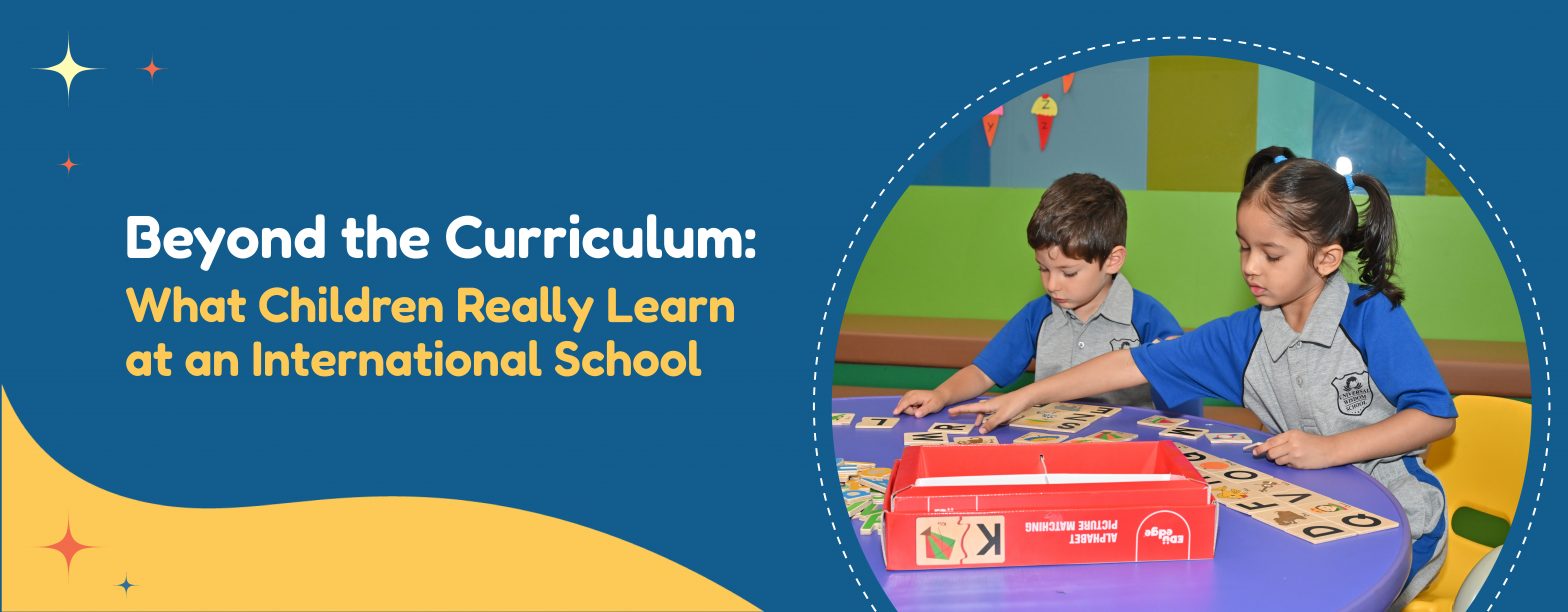
Beyond the Curriculum: What Children Really Learn in an International School
When parents assess schools, their primary focus is usually on the academic side of things: grades, curriculum, and university admissions.Yet, the greatest learning happens beyond the pages of textbooks. For example, at the Universal Wisdom School (UWS) which is a well-planned international learning environment, apart from acquiring book knowledge, the students also learn the skills, values, and attitudes necessary for succeeding in a globally connected world.
This is what defines the true international school experience, the ‘hidden curriculum’ that shapes who your child becomes.
What Does ‘Beyond the Curriculum’ Really Mean?
At its core, international school education focuses on holistic education, developing:
- Intellectual abilities
- Emotional intelligence
- Social awareness
- Ethical values
At UWS, this method is deeply integrated in daily learning with hands-on teaching, learning by doing activities, and interdisciplinary exposure.
According to UNESCO, education today must not only assist with academic achievement, but also contribute to the development of students’ social, emotional, and international skills in order to adequately prepare them for the challenges of the 21st century.
1. Critical Thinking & Problem-Solving in Real Contexts
One of the key benefits of international school education is the change in learning approach from memorisation to inquiry based learning.
For instance, at UWS, learning environments motivate:
- Asking questions
- Considering different solutions
- Applying learning in everyday situations
These are some of the ways to teach critical thinking and problem-solving skills. These approaches are in line with the research conducted by the OECD which reveals that critical thinking and problem-solving are the main 21st-century skills for future jobs. This directly supports critical thinking and problem-solving in diverse settings, helping students become independent thinkers.
2. Communication & Collaboration in Multicultural Environments
Students are exposed to a variety of viewpoints at international schools such as UWS, not just through projects done in collaboration, discussions and other activities, but even through their day to day interactions with the diverse community of the school.
In a nutshell, students learn:
- Effective communication
- Teamwork
- Respect for differing viewpoints
Research by the World Economic Forum identifies communication and collaboration as two of the most important skills required by the future workforce.
These are skills which international schools like UWS help students develop with the actual day to day school life. Such practical experiences especially in communication and collaboration and working with members of different cultural backgrounds, help build these skills in the students.
3. Social-Emotional Learning (SEL) & Empathy
At UWS, equal importance is given to emotional development through activities, peer interaction, and reflective learning.
Children develop:
- Self-awareness
- Emotional regulation
- Empathy
According to Collaborative for Academic, Social, and Emotional Learning, students engaged in SEL programmes show:
- 11% higher academic performance
- Improved behaviour and relationships
This highlights the importance of social emotional learning in international education and intercultural competence and empathy development.
4. Developing a Global Mindset
A defining feature of international school education is exposure to global perspectives.
At UWS, students engage with:
- Global themes
- Cultural awareness activities
- Real-world issues
The Asia Society emphasises that developing global competence helps students:
- Investigate the world
- Recognize perspectives
- Communicate ideas effectively
This fosters open-mindedness, tolerance, and global citizenship.
5. Adaptability, Resilience & Confidence
Children in international-style learning environments regularly face:
- New challenges
- Different perspectives
- Dynamic learning formats
At UWS, presentations, group work, and co-curricular activities help students step out of their comfort zones.
A study by the Harvard Graduate School of Education highlights that resilience and adaptability are critical for long-term success in both academics and careers. These are essential real-world skills from international school education.
6. Leadership, Initiative & Independence
At UWS, students are encouraged to:
- Take initiative in projects
- Participate in leadership opportunities
- Express their ideas confidently
This builds:
- Independence
- Decision-making skills
- Leadership abilities
The American Psychological Association notes that fostering independence in children contributes to higher self-confidence and better life outcomes.
7. Values, Ethics & Character Building
The value of international schools lies not just in academics, but in shaping responsible individuals.
At UWS, emphasis is placed on:
- Respect
- Responsibility
- Integrity
- Cultural sensitivity
According to UNICEF, value-based education plays a crucial role in developing socially responsible and ethical citizens.
This reflects how international schools shape character and moral awareness.
8. Extracurriculars & Service Learning: Where Real Learning Happens
At UWS, learning extends beyond the classroom through:
- Clubs and activities
- Sports
- Creative arts
- Community engagement
The National Education Association states that extracurricular participation improves:
- Academic outcomes
- Social skills
- Student engagement
These experiences are central to the hidden benefits of international schooling.
Can Traditional Schools Replicate This?
While many schools are evolving, international-style education as seen at UWS integrates:
- Inquiry-based learning
- Social-emotional development
- Global exposure
These elements are often more deeply embedded compared to traditional systems.
Do Children Lose Their Cultural Identity?
A common myth is that international schooling makes children ‘rootless.’
At UWS, children are encouraged to:
- Stay connected to their cultural roots
- Appreciate diversity
- Build a broader identity
This creates individuals who are both grounded and globally aware.
Long-Term Impact: Preparing for the Real World
The intangible outcomes of international school education include:
- Strong communication and networking skills
- Confidence in diverse environments
- Better readiness for global careers
- Adaptability in higher education
According to the QS Global Employer Survey, employers increasingly value soft skills like adaptability, communication, and problem-solving alongside academic knowledge.
Why Universal Wisdom School (UWS) Stands Out
At Universal Wisdom School, the focus is clear: Education that prepares children for life, not just exams.
Through:
- Holistic and experiential learning
- Strong focus on SEL and life skills
- Global exposure with local grounding
- Activity-driven and student-centric approach
UWS ensures students develop into confident, capable, and compassionate individuals.
Key Takeaways from an International Schooling
| Area | What Children Learn |
| Thinking | Critical thinking, problem-solving |
| Social Skills | Collaboration, communication |
| Emotional Growth | Empathy, resilience |
| Global Awareness | Cultural understanding |
| Personal Development | Confidence, leadership |
Final Thoughts
The true benefits of international school education go far beyond academics.
At institutions like Universal Wisdom School, children don’t just learn what to think, they learn how to think, adapt, collaborate, and lead.
Because in today’s world, success isn’t defined by marks alone, it’s defined by mindset, skills, and the ability to thrive anywhere.
FAQs
1. How do international schools foster intercultural understanding?
Through exposure to diverse perspectives, collaborative learning, and global themes, practices actively integrated at UWS.
2. What 21st-century skills do they focus on?
Critical thinking, communication, collaboration, adaptability, and leadership.
3. Can these skills be developed in traditional schools?
Yes, but international-style systems like UWS integrate them more consistently into daily learning.
4. Do children lose their cultural identity?
No, schools like UWS balance global exposure with strong cultural grounding.
5. How does this impact future careers?
Students are better prepared for global workplaces, higher education, and dynamic career paths.