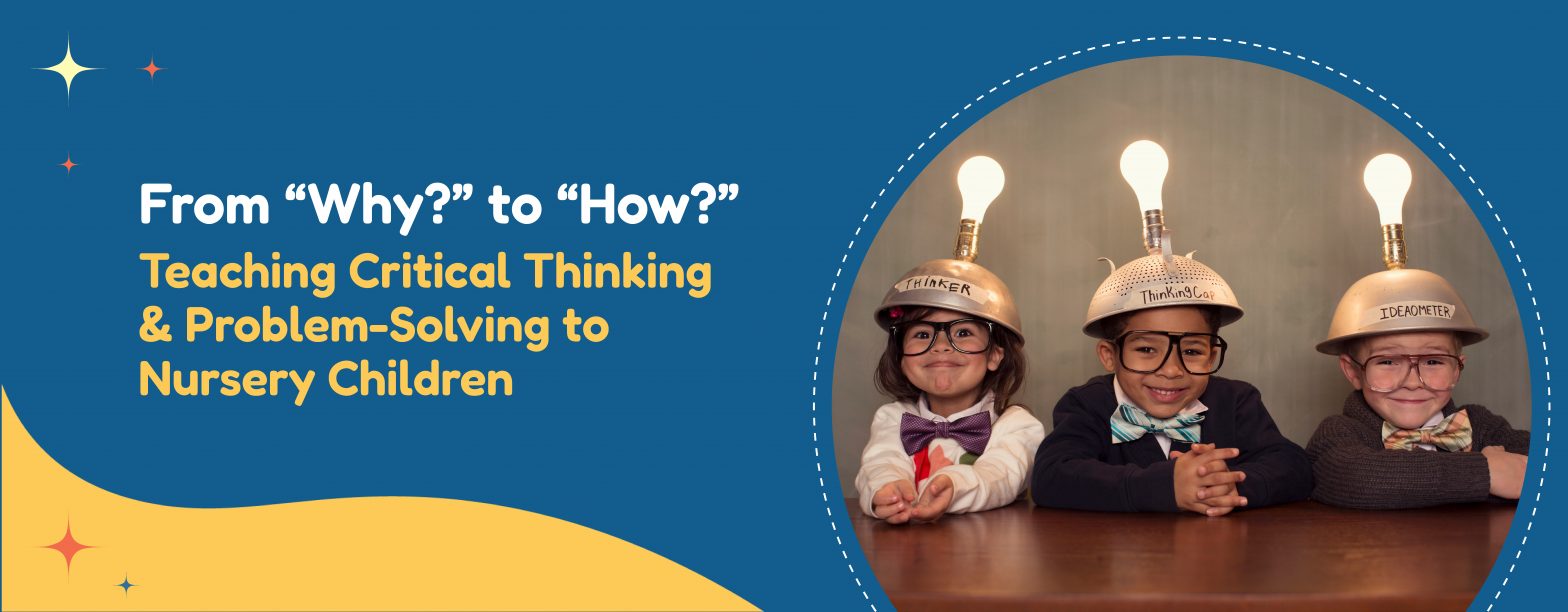
How to Teach Critical Thinking & Problem-Solving to Nursery-Aged Children
How to Teach Critical Thinking & Problem-Solving to Nursery Children
In today’s world, simply memorising answers is not a sufficient approach to education. The real differentiator for children’s success is their capability to think, ask questions, and independently come up with solutions to problems. And the good news is, these skills can start developing as early as nursery.
If you’ve ever wondered how to nurture critical thinking for kids or build problem-solving skills for children, this blog breaks it down into simple, practical steps you can use at home and school.
What Does “Critical Thinking” Look Like in a 3-5 Year-Old?
Critical thinking in young children is not about debating or doing complex logical reasoning. Rather, it manifests in small, ordinary moments such as:
- Asking “why” and “how”
- Figuring out the different ways to stack blocks without them falling over
- Trying different ways to solve a puzzle, encouraging different approaches to finding a solution
- Making choices (“I want the red cup because it’s bigger”)
At this stage, early childhood education is about supporting children to explore their natural curiosity, be creative, and learn through trial and error. The concept of right or wrong answers is hardly the focus.
At institutions like Universal Wisdom School, these abilities are introduced early through guided play, inquiry-based learning, and carefully planned nursery activities that foster children to think on their own.
Why Is It Important in Early Childhood?
Several findings from child development research have demonstrated that early thinking abilities can lead to:
- Better academic readiness
- Stronger emotional regulation
- Improved decision-making abilities
- Higher confidence in learning situations
The cultivation of problem-solving skills for kindergarten readiness assists young learners transition smoothly into formal schooling. At the same time, it is an effective tool in helping parents understand how the child is coping with the new environment. Progressive schools like Universal Wisdom School are leaders in integrating critical thinking skills in their early childhood education programmes to assure that children are not only prepared for school but also for the challenges of life.
Critical Thinking vs Rote Learning
| Rote Learning | Critical Thinking |
| Memorising answers | Understanding “why” |
| One correct answer | Multiple possible solutions |
| Passive learning | Active exploration |
| Teacher-led | Child-led thinking |
For nursery-aged children, play-based learning for critical skills is far more effective than memorisation.
Step-by-Step Guide to Teaching Critical Thinking at Home
1. Ask Open-Ended Questions
Instead of yes/no questions, try:
- “What do you think will happen if…?”
- “Why did that fall?”
- “How can we fix this?”
These encourage teaching kids to think for themselves.
2. Let Them Struggle (A Little!)
It’s tempting to jump in, but pause.
If a toy isn’t working, ask:
- “What can you try next?”
This builds nurturing young problem solvers rather than dependent learners.
3. Use Everyday Problem-Solving Moments
Turn daily situations into learning:
- Spilled water → “How can we clean this?”
- Missing toy → “Where did you last see it?”
- Broken crayon → “What can we do now?”
Here we see actual instances of how to teach problem-solving to toddlers.
At schools like Universal Wisdom School, teachers intentionally set up these little problem-solving situations in the course of the day. In this way, kids get to practice and develop their problem-solving thinking skills, and at the same time, they build up their self-confidence.
4. Encourage Decision-Making
Offer simple choices:
- “Do you want to wear the blue or red shirt?”
- “Which story should we read?”
Decision-making strengthens reasoning and independence.
5. Model Thinking Out Loud
Say things like:
- “Hmm, this doesn’t fit. Maybe I’ll try turning it.”
Children learn thinking patterns by observing adults.
5 Fun Critical Thinking Activities for 3-5 Year Olds
Many of these critical thinking activities for 3-5 year olds are already part of daily classroom experiences at Universal Wisdom School, where play is designed with purpose:
Puzzles & Sorting Games
- Shape sorters
- Matching games
- Simple jigsaw puzzles
These improve logic and pattern recognition.
Building Blocks
- Encourage children to build towers or bridges
- Ask: “How can we make it stronger?”
Great for developing reasoning skills in nursery school.
Pretend Play
- Role-play shops, kitchens, or doctors
- Introduce small challenges (“We ran out of milk – what now?”)
This boosts creativity and flexible thinking.
Treasure Hunts
- Give clues instead of directions
- Example: “Look somewhere soft and cosy”
Encourages deduction and exploration.
Daily Questions to Build Thinking Skills
These simple critical thinking exercises for children require zero prep:
- “What was your favourite part of today? Why?”
- “What would you do if it started raining inside the house?”
- “How can we share this toy?”
- “What else can we use this for?”
Best Types of Play for Critical Thinking
Different play types support different skills:
| Type of Play | Skill Developed |
| Blocks & construction | Spatial reasoning |
| Puzzles | Logical thinking |
| Pretend play | Creativity & problem-solving |
| Outdoor play | Decision-making & adaptability |
Handling Frustration During Problem-Solving
It’s normal for children to feel stuck.
Signs of frustration:
- Giving up quickly
- Crying or anger
- Saying “I can’t do it”
What you can do:
- Recognise the emotion: “That’s a difficult situation, isn’t it?”
- Give clues instead of answers
- Break the task into smaller steps
This helps with dealing with frustration during problem-solving activities.
At UWS, teachers are trained to provide children with strategies for overcoming frustration in a way that does not take away their control, thus assisting them in building resilience along with problem-solving skills.
What NOT to Do
Avoid these common mistakes:
- Solving problems immediately for them
- Expecting perfect answers
- Over-correcting or criticising
- Pushing too hard too fast
These can hinder developing reasoning skills in nursery school.
How to Assess Critical Thinking (Without Tests)
You don’t need exams to measure progress. Observe:
- Do they ask questions?
- Do they try different solutions?
- Can they explain their choices?
- Do they persist after failure?
These are key indicators of growth in critical thinking for kids.
Instead of traditional testing, schools like Universal Wisdom School rely on observation-based assessment methods to track how children think, explore, and solve problems in real-time.
Balancing Independence with Safety
Encourage thinking, but set boundaries:
- Let them explore within safe limits
- Guide decisions when necessary
- Explain rules (“We don’t touch hot things because…”)
This helps balance independence and responsibility. This balance is carefully maintained in structured environments like Universal Wisdom School, where children are encouraged to explore within safe and guided boundaries.
How Schools Like UWS Support Critical Thinking
At Universal Wisdom School, critical thinking is not treated as an add-on, it’s built into everyday learning. Through a blend of play-based learning, collaborative activities, and inquiry-driven teaching, children are encouraged to:
- Ask meaningful questions
- Explore multiple solutions
- Engage in hands-on nursery activities
- Develop confidence in their own decision-making
This approach ensures children develop strong problem-solving skills for kindergarten readiness while enjoying the process of learning.
Explore more about UWS’ approach here: https://universalwisdomschool.in/
Final Thoughts
Teaching critical thinking and problem-solving for children doesn’t require expensive tools or structured lessons. It’s about creating an environment where curiosity is encouraged, mistakes are welcomed, and thinking is celebrated.
Because when children learn how to think, not just what to think, they carry that skill for life.
Further Reading & References
- Harvard Center on the Developing Child
- UNICEF – Early Childhood Development
- American Academy of Pediatrics (AAP)
- National Association for the Education of Young Children (NAEYC)
- Zero to Three
- Raising Children Network
FAQs
1. Can critical thinking really be taught at such a young age?
Yes. Through play, conversation, and guided exploration, children naturally develop these skills.
2. What if my child struggles with problem-solving?
Every child develops at their own pace. Focus on encouragement rather than outcomes.
3. How much time should I spend on these activities daily?
Even 15-20 minutes of mindful interaction can make a big difference.
4. Are toys necessary for developing these skills?
Not always. Everyday situations and conversations are equally powerful.
5. Is screen time helpful for critical thinking?
Interactive, limited screen time can help, but real-world play is far more effective.